
Learn It!
The Leadership Framework Toolkit
Every one of the five Leadership Frameworks follows the same pattern. Use the path below to move through any framework, or jump straight to the part of the toolkit you need.
- Learn
- Ask
- Assess
- Discuss
- Act
Ask
Leadership Questions
Ten questions for every framework, each closing with one Enduring Principle.
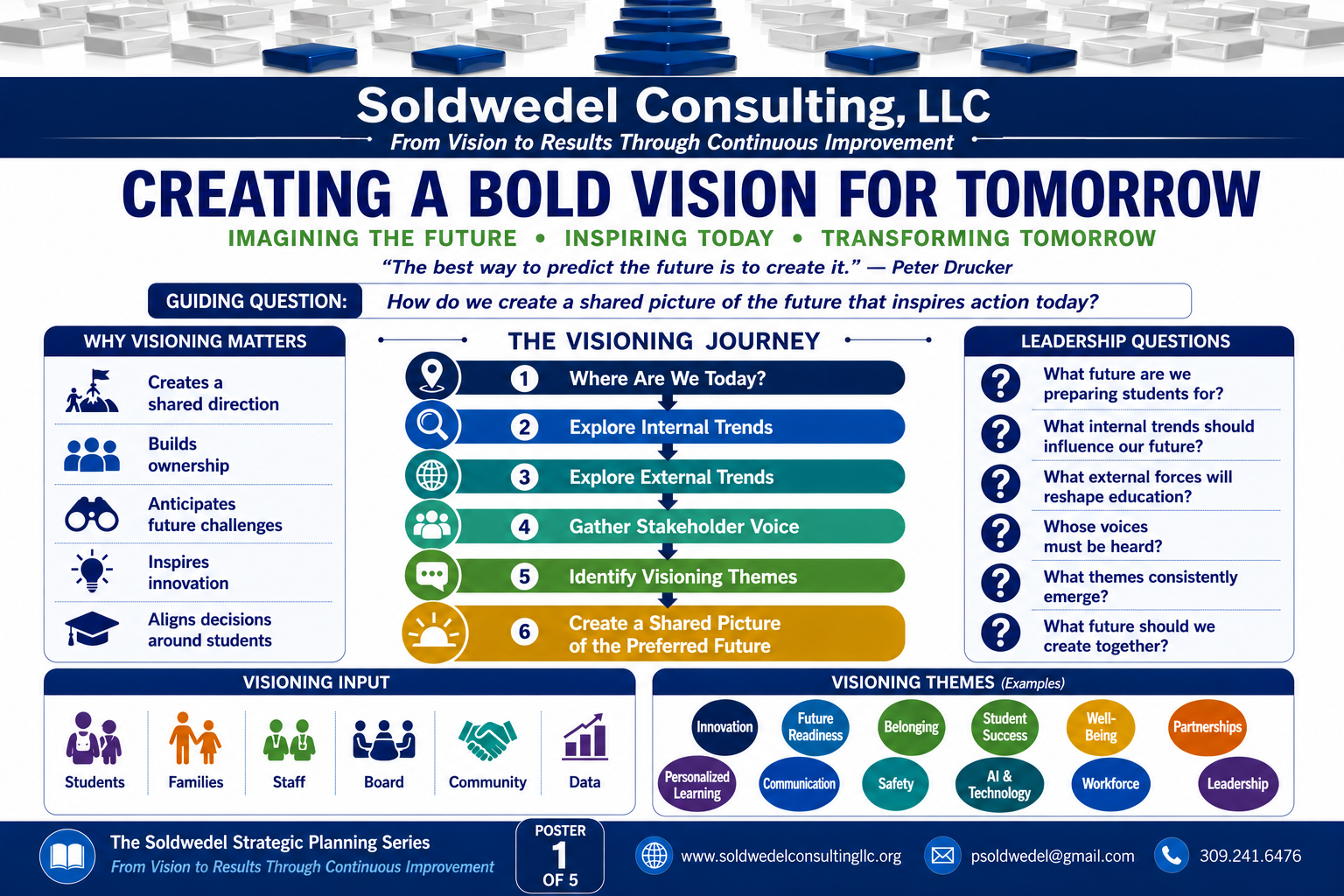
Framework 1 — Creating a Bold Vision for Tomorrow
Ten questions ⌄
“What future are we committed to creating together?”
- Why do we exist?What is our ultimate purpose, and how does it inspire the work we do every day?
- What future do we want to create for our students?If we were designing our school system from scratch, what would success look like?
- What changes are shaping the future of education?What emerging trends, opportunities, and challenges must we anticipate rather than react to?
- What do our students, staff, families, and community hope for?How can we ensure every voice helps shape our vision?
- What should never change?Which core beliefs and values define who we are regardless of how education evolves?
- What must change?What practices, assumptions, or systems no longer serve our learners or our mission?
- What would success look like ten years from now?If our vision became reality, what would students, staff, and families experience every day?
- What barriers stand between where we are and where we want to be?What challenges must we acknowledge and overcome to realize our preferred future?
- How bold are we willing to be?Are we creating a vision that inspires innovation and transformation, or simply improving what already exists?
- How will our vision influence every decision we make?How will we ensure our vision becomes the foundation for priorities, resource allocation, and daily actions rather than words on a page?
A bold vision is not a prediction of the future—it is a commitment to create one.
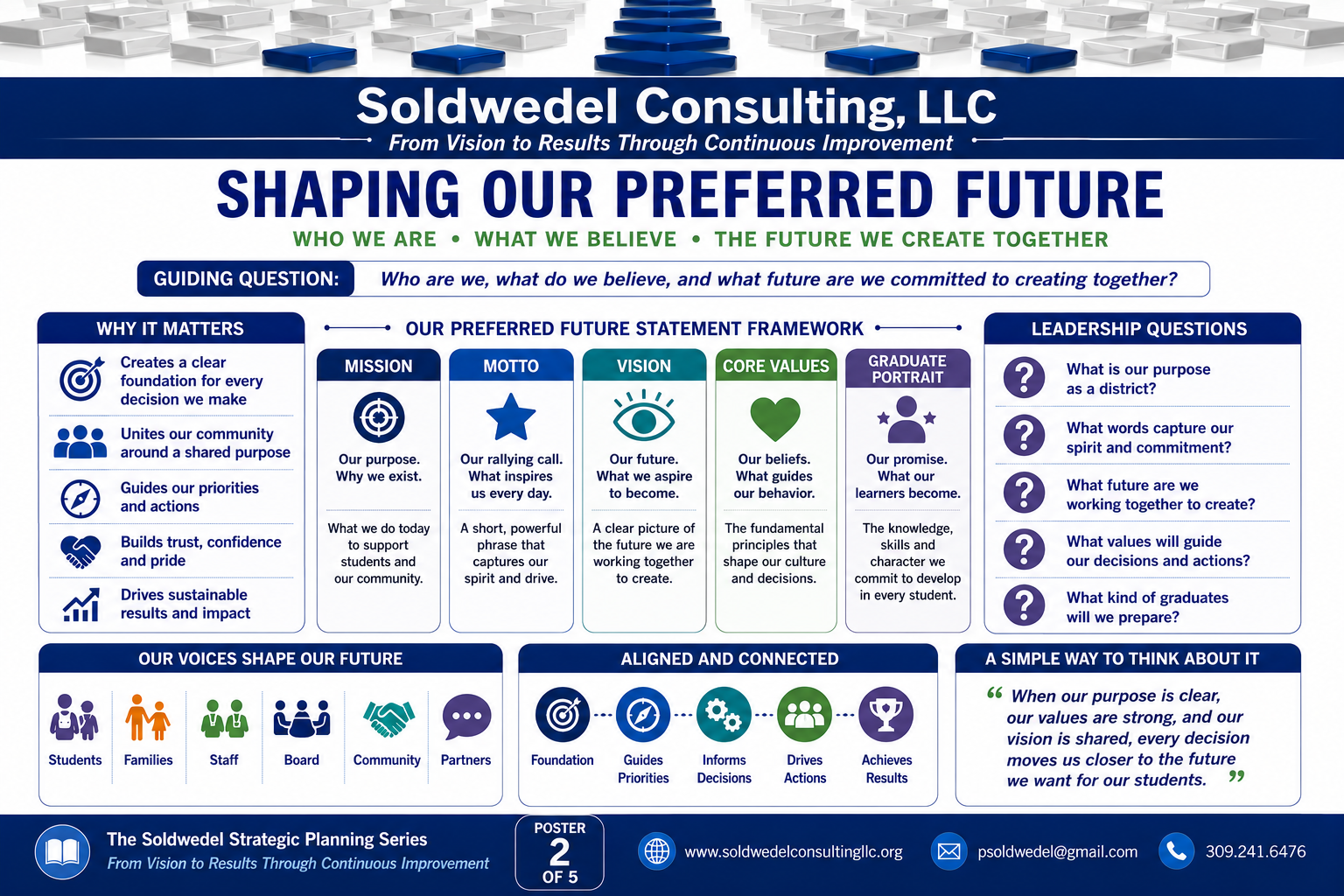
Framework 2 — Shaping Our Preferred Future
Ten questions ⌄
“Who are we becoming, and what will it take to get there?”
- Why do we exist?What is our fundamental purpose, and how does it guide every decision we make?
- What future are we committed to creating?What do we want our district, schools, and learners to become over the next five to ten years?
- What beliefs and values will define our culture?What principles will guide our decisions, relationships, and behaviors every day?
- What knowledge, skills, and mindsets should every graduate possess?How do we define success for every student beyond academic achievement?
- What kind of educators and leaders will make this future possible?What expectations do we have for the adults who serve our students?
- How will we ensure every learner belongs, grows, and thrives?What commitments will demonstrate our dedication to equity, opportunity, and success for all?
- Is our Preferred Future clear enough to inspire action?Can every student, staff member, family, and community member understand, remember, and embrace it?
- How will our Preferred Future shape our strategic priorities?How will it influence our goals, resource allocation, and daily decision-making?
- What evidence will tell us we are becoming the organization we aspire to be?How will we recognize progress toward our preferred future?
- How will we keep our Preferred Future alive?What leadership practices will ensure it becomes the foundation of our culture rather than simply words in a strategic plan?
A preferred future becomes reality when a shared vision is translated into shared beliefs, shared expectations, and shared action.
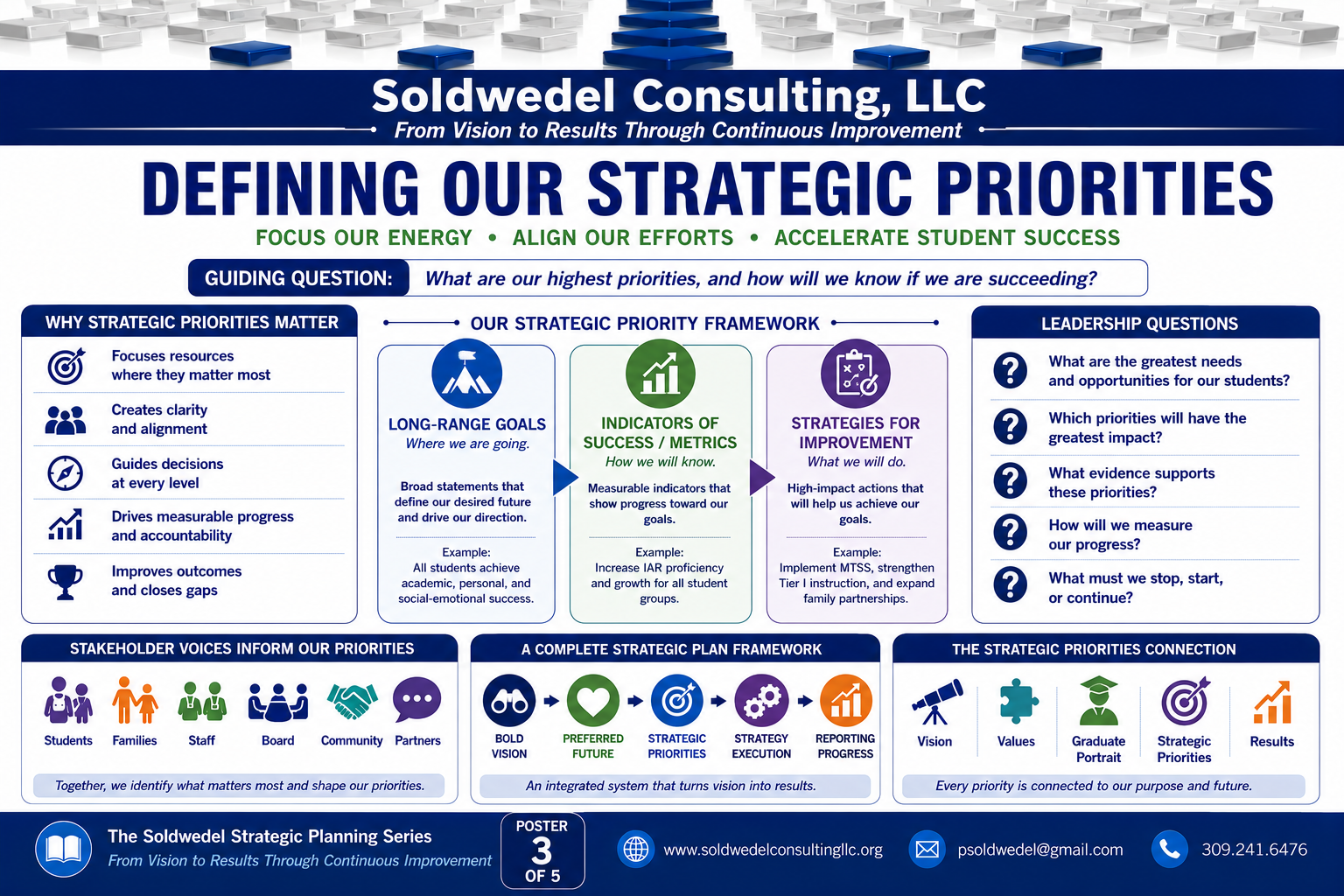
Framework 3 — Defining Our Strategic Priorities
Ten questions ⌄
“What matters most, and how will we know we are making a difference?”
- What are the most important outcomes we must achieve?If we could accomplish only a few things over the next three to five years, what would make the greatest difference for our students?
- What evidence tells us these should be our priorities?What data, research, stakeholder feedback, and current realities support our choices?
- What challenges or opportunities require our greatest attention?Where do the greatest gaps, needs, or opportunities for improvement exist?
- What goals will have the greatest impact?Which long-range goals will most effectively move us toward our preferred future?
- How will we know we are making progress?What indicators, measures, and targets will tell us whether we are succeeding?
- What strategies will produce the greatest results?What high-leverage actions and initiatives are most likely to achieve our goals?
- How will we align our resources with our priorities?How will our time, people, budget, technology, and professional learning reflect what matters most?
- How will we maintain focus?What will we stop doing so we can concentrate our energy on our highest priorities?
- How will every department and school contribute?How will individual action plans align with and support the district's strategic priorities?
- How will we ensure our priorities remain relevant?How will we review, refine, and adjust our priorities as conditions change?
Strategic priorities turn a bold vision into focused action by concentrating the organization's energy on what matters most.
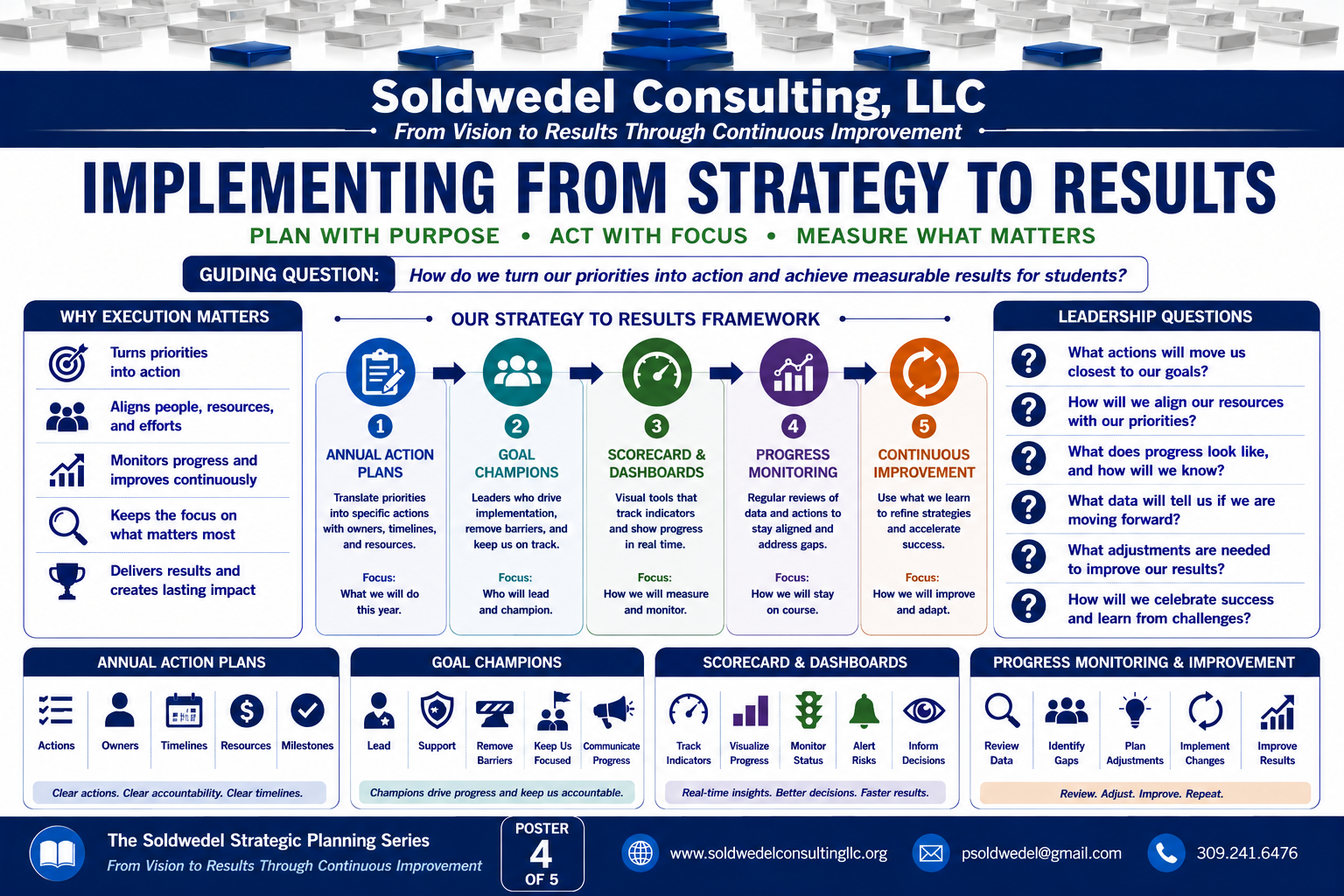
Framework 4 — Implementing from Strategy to Results
Ten questions ⌄
“How will we transform our strategy into measurable results?”
- How will we turn our strategic plan into daily action?What structures, processes, and expectations will move our plan from paper to practice?
- Who is responsible for achieving each priority?How will we establish clear ownership, accountability, and support for every goal and strategy?
- What actions must we take first?What are our highest-leverage next steps, and how will we sequence the work for success?
- How will we monitor progress?What scorecards, dashboards, milestones, and checkpoints will help us know if we are on track?
- What evidence will guide our decisions?How will we use leading and lagging indicators to evaluate progress and adjust our actions?
- How will we build the capacity of our people?What coaching, professional learning, collaboration, and resources will help staff successfully implement our strategies?
- How will we remove barriers to success?What obstacles could prevent implementation, and how will we proactively address them?
- How will we sustain momentum?How will we celebrate successes, maintain focus, and keep our strategic priorities visible throughout the year?
- How will we continuously improve?How will we use feedback, reflection, and learning to refine our strategies and strengthen results?
- How will we ensure implementation becomes part of our culture?How will we create a leadership system where executing, monitoring, learning, and improving become the way we work every day?
A strategic plan creates the direction; disciplined implementation creates the results.
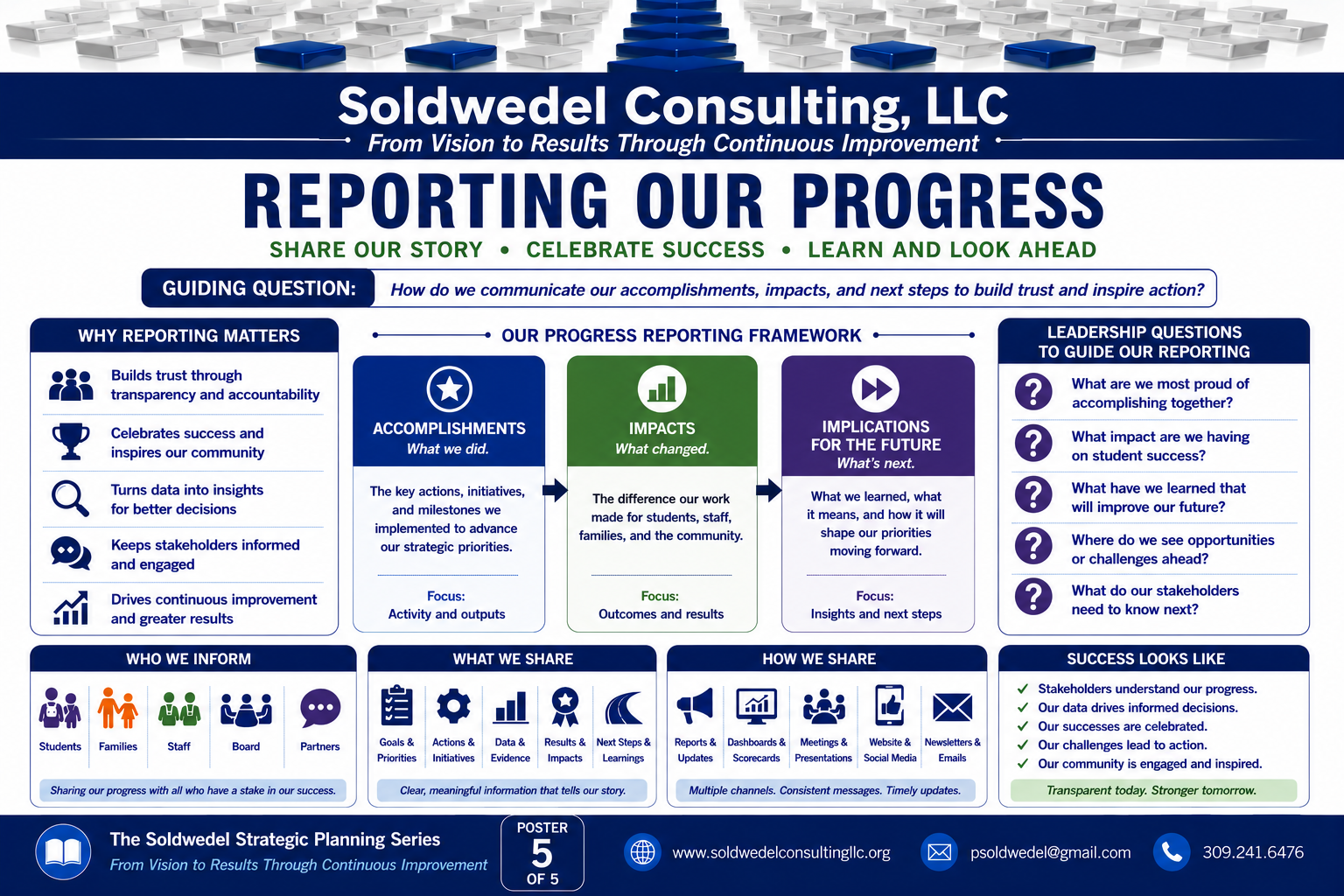
Framework 5 — Reporting Our Progress
Ten questions ⌄
“What difference did our work make, and where do we go from here?”
- What did we accomplish?What milestones, initiatives, and commitments did we successfully complete?
- What impact did our work have?How did our actions improve student learning, organizational performance, or stakeholder experiences?
- What evidence demonstrates our progress?What data, stories, examples, and stakeholder feedback best illustrate our results?
- Did we achieve the outcomes we intended?How do our results compare with the goals, indicators, measures, and targets we established?
- What did we learn?What successes, challenges, and unexpected insights will help us improve in the future?
- What should we celebrate?Which accomplishments and contributions deserve recognition, and how will we acknowledge those who made them possible?
- What still needs our attention?Where do performance gaps remain, and what opportunities for improvement have emerged?
- How will we communicate our results?How can we tell our story in a way that builds understanding, trust, confidence, and support?
- What are our next steps?Based on what we learned, what actions should we continue, modify, begin, or stop?
- How will our results shape the future?How will today's learning influence tomorrow's priorities, strategies, and decisions?
Reporting results is not the end of the journey—it is the beginning of the next cycle of improvement.
Learn
What Skills Leaders Learn
Each framework develops a distinct set of leadership skills while building toward comprehensive strategic leadership.
1 Creating a Bold Vision for Tomorrow — leaders learn to see the future
Ten skills ⌄
Leaders learn to think beyond today's challenges and focus on the future they want to create.
They learn to:
- Look beyond daily operations
- Anticipate future trends
- Think long-term rather than short-term
- Recognize opportunities before others do
Leaders learn how to paint a compelling picture of a preferred future that inspires others.
They learn to:
- Describe success clearly
- Create an inspiring direction
- Connect today's work to tomorrow's possibilities
- Build optimism and confidence
Leaders learn how to understand the forces shaping education.
They learn to:
- Analyze internal strengths and challenges
- Monitor educational trends
- Understand community expectations
- Identify emerging opportunities and risks
Leaders learn to gather meaningful input from stakeholders.
They learn to:
- Facilitate productive conversations
- Ask powerful questions
- Listen for common themes
- Build ownership through engagement
Leaders learn to combine evidence with vision.
They learn to:
- Analyze multiple sources of data
- Identify important patterns
- Separate facts from assumptions
- Use evidence to shape future direction
Leaders become more effective at leading groups through important conversations.
They learn to:
- Guide collaborative discussions
- Build consensus
- Manage differing opinions
- Keep conversations focused on outcomes
Leaders learn to see how every part of the organization connects.
They learn to:
- Recognize relationships among initiatives
- Understand cause-and-effect
- Avoid isolated solutions
- Build organizational coherence
Leaders learn to communicate the vision in ways that inspire commitment.
They learn to:
- Tell a compelling story
- Explain the “why”
- Inspire action
- Communicate consistently
Leaders learn how to prepare people for change before asking them to change.
They learn to:
- Build urgency
- Reduce resistance
- Create shared ownership
- Generate enthusiasm for the future
Leaders develop the discipline of continually asking what comes next.
They learn to:
- Keep the organization future-focused
- Balance today's realities with tomorrow's possibilities
- Challenge assumptions
- Lead with hope and purpose
Summary
By the end of this framework, leaders will have strengthened their ability to:
- Think strategically
- Create an inspiring vision
- Analyze trends and evidence
- Listen deeply
- Facilitate meaningful conversations
- Build consensus
- Communicate with purpose
- Lead change confidently
- See the organization as an interconnected system
- Keep everyone focused on the future
Creating a bold vision is not simply about writing a statement. It is about developing leaders who can see possibilities others cannot, inspire people to pursue them, and unite an organization around a shared future.
2 Shaping Our Preferred Future — leaders learn to define and align the future
Ten skills ⌄
Leaders learn how to ensure every part of the organization points in the same direction.
They learn to:
- Align mission, vision, values, and goals
- Eliminate conflicting priorities
- Create organizational coherence
- Connect daily work to long-term purpose
Leaders learn how to lead from purpose rather than programs.
They learn to:
- Clarify why the organization exists
- Keep decisions grounded in purpose
- Inspire commitment through meaning
- Maintain focus during change
Leaders learn how to create direction with people rather than for people.
They learn to:
- Engage diverse voices
- Build consensus
- Create shared ownership
- Honor different perspectives
Leaders learn how the major components of a successful organization fit together.
They learn to:
- Define organizational identity
- Align culture with strategy
- Clarify expectations
- Build a unified leadership framework
Leaders learn to make decisions that reflect what the organization stands for.
They learn to:
- Use core values to guide decisions
- Resolve competing priorities
- Model organizational values
- Build trust through consistency
Leaders learn how to clearly define what success looks like.
They learn to:
- Describe desired outcomes
- Develop Graduate, Educator, and System Portraits
- Identify essential competencies
- Focus the organization on meaningful results
Leaders learn how to communicate a preferred future that people understand and embrace.
They learn to:
- Explain complex ideas simply
- Tell a compelling organizational story
- Create consistent messaging
- Inspire confidence in the future
Leaders learn how to intentionally shape organizational culture.
They learn to:
- Reinforce shared beliefs
- Build commitment
- Strengthen relationships
- Foster a sense of belonging
Leaders learn how to build lasting partnerships.
They learn to:
- Engage students, staff, families, and the community
- Build trust through collaboration
- Create meaningful opportunities for input
- Develop shared responsibility for success
Leaders learn how to ensure everyone leads from the same playbook.
They learn to:
- Create common language
- Establish shared expectations
- Align leadership practices
- Build consistency across schools and departments
Summary
By the end of this framework, leaders will have strengthened their ability to:
- Align people around a common purpose
- Build organizational identity
- Lead through shared values
- Define what success looks like
- Develop Graduate, Educator, and System Portraits
- Create organizational coherence
- Build trust through collaboration
- Shape a positive culture
- Communicate with clarity and inspiration
- Lead with consistency
Great organizations are built on more than a compelling vision. They are built on a shared purpose, common values, and a clear definition of success that guide every decision, every action, and every relationship.
3 Defining Our Strategic Priorities — leaders learn to focus the future
Ten skills ⌄
Leaders learn how to distinguish the important from the merely urgent.
They learn to:
- Identify the highest-impact priorities
- Focus on what matters most
- Eliminate competing initiatives
- Allocate attention strategically
Leaders learn to make strategic choices based on evidence rather than opinion.
They learn to:
- Analyze multiple sources of data
- Identify meaningful trends
- Validate assumptions
- Use evidence to establish priorities
Leaders learn how to establish clear, meaningful long-range goals.
They learn to:
- Write strategic goals
- Define measurable outcomes
- Align goals with the vision
- Create a roadmap for success
Leaders learn how to translate vision into a practical plan.
They learn to:
- Develop strategic priorities
- Connect goals, strategies, and actions
- Sequence initiatives effectively
- Balance ambition with feasibility
Leaders learn to align people, time, and money with strategic priorities.
They learn to:
- Allocate resources intentionally
- Invest where impact is greatest
- Eliminate misaligned efforts
- Support strategic initiatives
Leaders learn how to define success and monitor progress.
They learn to:
- Develop meaningful indicators
- Select appropriate measures
- Establish realistic targets
- Monitor organizational performance
Leaders learn how to ensure organizational systems support strategic priorities.
They learn to:
- Align budgets with priorities
- Connect professional learning to goals
- Coordinate departments
- Build organizational coherence
Leaders learn how to gain commitment to difficult strategic choices.
They learn to:
- Facilitate productive discussions
- Build agreement around priorities
- Navigate competing interests
- Create shared ownership
Leaders learn to maintain focus despite competing demands.
They learn to:
- Resist initiative overload
- Say “no” to distractions
- Stay focused on long-term outcomes
- Maintain organizational momentum
Leaders learn how to prepare an organization for successful implementation.
They learn to:
- Clarify responsibilities
- Define expected outcomes
- Establish timelines
- Create structures for accountability
Summary
By the end of this framework, leaders will have strengthened their ability to:
- Prioritize what matters most
- Analyze data strategically
- Set meaningful goals
- Develop coherent strategic plans
- Align resources with priorities
- Measure progress effectively
- Build organizational alignment
- Facilitate consensus
- Maintain strategic focus
- Establish accountability for results
Leadership is not measured by how many initiatives you launch, but by your ability to identify the few priorities that matter most and align your organization around achieving them.
4 Implementing from Strategy to Results — leaders learn to deliver the future
Ten skills ⌄
Leaders learn how to turn strategic plans into measurable results.
They learn to:
- Translate strategy into action
- Move from planning to implementation
- Maintain focus on desired outcomes
- Build momentum toward goals
Leaders learn how to organize work for successful execution.
They learn to:
- Develop effective action plans
- Establish realistic timelines
- Sequence initiatives strategically
- Clarify responsibilities
Leaders learn how to mobilize people around shared priorities.
They learn to:
- Build high-performing teams
- Clarify roles and expectations
- Foster collaboration
- Empower others to lead
Leaders learn how to manage complex initiatives.
They learn to:
- Coordinate multiple projects
- Monitor milestones
- Manage risks
- Keep implementation on schedule
Leaders learn how to track progress throughout implementation.
They learn to:
- Monitor key performance indicators
- Use scorecards and dashboards
- Identify implementation gaps
- Recognize early signs of success or concern
Leaders learn how to improve results through ongoing learning.
They learn to:
- Analyze implementation data
- Reflect on progress
- Adjust strategies when needed
- Strengthen organizational effectiveness over time
Leaders learn how to help people successfully implement change.
They learn to:
- Build commitment to new initiatives
- Address resistance constructively
- Sustain motivation
- Reinforce desired practices
Leaders learn how to develop the people responsible for implementation.
They learn to:
- Provide meaningful feedback
- Support professional growth
- Build leadership capacity
- Create a culture of continuous learning
Leaders learn how to create responsibility without creating fear.
They learn to:
- Set clear expectations
- Monitor commitments
- Celebrate progress
- Address challenges with support and clarity
Leaders learn how to adapt while remaining focused on the destination.
They learn to:
- Respond to changing conditions
- Solve implementation challenges
- Make informed adjustments
- Balance flexibility with strategic discipline
Summary
By the end of this framework, leaders will have strengthened their ability to:
- Execute strategy with discipline
- Develop effective implementation plans
- Lead high-performing teams
- Manage complex projects
- Monitor progress using meaningful data
- Foster continuous improvement
- Lead organizational change
- Coach and develop others
- Build a culture of accountability
- Adapt while staying focused on strategic goals
A strategic plan creates the possibility of success. Effective implementation turns that possibility into reality. Great leaders are not remembered for the plans they wrote, but for the results they achieved through disciplined execution.
5 Reporting Our Progress — leaders learn to demonstrate and sustain the future
Ten skills ⌄
Leaders learn how to measure what matters most.
They learn to:
- Identify meaningful indicators
- Select appropriate measures
- Monitor progress toward strategic goals
- Focus on outcomes rather than activities
Leaders learn how to turn data into meaningful insights.
They learn to:
- Interpret trends and patterns
- Distinguish accomplishments from impacts
- Identify strengths and opportunities
- Use evidence to guide future decisions
Leaders learn how to communicate results with clarity and purpose.
They learn to:
- Tell the organization's story
- Explain progress in understandable language
- Share successes and challenges honestly
- Build confidence through transparency
Leaders learn how to connect evidence with meaningful narratives.
They learn to:
- Celebrate accomplishments
- Demonstrate organizational impact
- Illustrate progress with evidence
- Inspire continued commitment through stories
Leaders learn how to build a culture of responsibility and ownership.
They learn to:
- Report progress openly
- Accept responsibility for results
- Reinforce commitments
- Foster trust through transparency
Leaders learn how to determine whether strategies are producing the intended results.
They learn to:
- Assess program effectiveness
- Evaluate implementation quality
- Measure organizational impact
- Learn from successes and setbacks
Leaders learn how to use reporting as a catalyst for ongoing growth.
They learn to:
- Reflect on lessons learned
- Identify next steps
- Adjust strategies based on evidence
- Build a culture of continuous learning
Leaders learn how to strengthen relationships through meaningful communication.
They learn to:
- Share progress with staff, families, boards, and the community
- Invite feedback
- Celebrate collective success
- Build confidence in the organization's direction
Leaders learn how to use results to make better future decisions.
They learn to:
- Prioritize future investments
- Refine organizational strategies
- Allocate resources more effectively
- Focus improvement efforts where they matter most
Leaders learn how to reflect on both outcomes and their own leadership.
They learn to:
- Evaluate leadership effectiveness
- Learn from experience
- Recognize accomplishments and challenges
- Model a growth mindset for the organization
Summary
By the end of this framework, leaders will have strengthened their ability to:
- Measure meaningful results
- Analyze and interpret performance data
- Communicate progress clearly
- Tell compelling stories with evidence
- Build accountability and trust
- Evaluate organizational effectiveness
- Lead continuous improvement
- Engage stakeholders through transparency
- Make informed strategic decisions
- Reflect and grow as leaders
Great leaders do not report results simply to describe the past. They use evidence, stories, and reflection to build trust, strengthen accountability, celebrate progress, and shape an even better future.
The Complete Leadership Journey
| Framework | Leaders Learn To… |
|---|---|
| 1. Creating a Bold Vision for Tomorrow | See the future. |
| 2. Shaping Our Preferred Future | Define the future. |
| 3. Defining Our Strategic Priorities | Focus the future. |
| 4. Implementing from Strategy to Results | Deliver the future. |
| 5. Reporting Our Progress | Demonstrate and improve the future. |
See it in action
Success Stories
Framework 1Creating a Bold Vision for Tomorrow
- Visioning Surveys Listening Before LeadingSoldwedel Consulting
- Family Vision Forums From Listening to PartnershipSoldwedel Consulting
- A Vision for Early Readiness From Hoping for Better Results to Creating ThemSoldwedel Consulting
- Learning from Others The XQ High School Transformation JourneySoldwedel Consulting
- Future-Ready Schools When Students Challenge Adults to Rethink the FutureSoldwedel Consulting
Framework 2Shaping Our Preferred Future
Framework 3Defining Our Strategic Priorities
Framework 4Implementing from Strategy to Results
Framework 5Reporting Our Results
Act
Promises and Commitments
“Knowledge changes our thinking. Commitments change our leadership.” Make promises to yourselves and your teams.
Framework 1 — Creating a Bold Vision for Tomorrow
As a leader, I commit to…
- …spending time thinking about tomorrow, not just managing today.
- …listening carefully to students, staff, families, and our community before defining our vision.
- …creating a vision that inspires people rather than simply satisfies a planning requirement.
- …helping every member of our organization understand where we are going and why it matters.
- …keeping our vision visible in our daily leadership decisions.
Does my calendar reflect the future I say I want to create?
Framework 2 — Shaping Our Preferred Future
I commit to…
- …ensuring our mission, vision, values, and Graduate Portrait tell one consistent story.
- …making our beliefs visible through our actions.
- …using our Preferred Future to guide difficult decisions.
- …protecting our culture as intentionally as our performance.
- …helping every employee see themselves in our future.
Are we becoming the organization we described?
Framework 3 — Defining Our Priorities
I commit to…
- …focusing on what matters most.
- …saying “no” to initiatives that do not advance our priorities.
- …using evidence rather than opinions to determine our direction.
- …aligning people, time, and resources with our highest priorities.
- …continually asking whether our work improves student success.
Are we busy…or are we strategically focused?
Framework 4 — Implementing from Strategy to Results
I commit to…
- …moving beyond planning into disciplined implementation.
- …providing clarity so every person understands their role.
- …monitoring progress consistently rather than waiting until the end.
- …removing barriers that prevent successful implementation.
- …celebrating progress while continuously improving.
Are our best ideas becoming our daily practices?
Framework 5 — Reporting Our Results
I commit to…
- …measuring what truly matters.
- …telling our story honestly and transparently.
- …celebrating accomplishments while examining our impact.
- …using results to improve rather than defend our work.
- …earning trust through evidence and accountability.
Does our reporting create confidence in where we are going next?
Strategic leadership is not defined by what we know. It is defined by what we consistently choose to do. Before beginning the next framework, write one commitment you will put into practice immediately. Leadership changes one decision at a time.
Assess · Discuss
Leadership Capacity Assessments
Strategic Leadership Capacity Assessment that follows the entire leadership journey:
| Framework | The question it answers |
|---|---|
| 1. Creating a Bold Vision for Tomorrow | Where are we going? |
| 2. Shaping Our Preferred Future | Who are we becoming? |
| 3. Defining Our Priorities | What matters most? |
| 4. Implementing from Strategy to Results | How will we make it happen? |
| 5. Reporting Our Results | How do we know we made a difference, and how do we tell our story? |
That's a complete strategic leadership cycle. I could easily imagine districts using all five assessments annually—not just as chapter exercises, but as the foundation for leadership retreats, board planning sessions, and strategic plan reviews. I believe they have the potential to become one of the signature tools in your Playbook.
Leadership Assessments help leaders evaluate their current reality. Leadership Commitments turn learning into action.
Directions
Using the scale below, assess your district's current leadership capacity for each question. Discuss your rating as a team and identify the evidence or examples that support your assessment.
1 Creating a Bold Vision for Tomorrow
Full assessment ⌄
A bold vision provides direction, inspires action, and creates a shared understanding of the future. This Leadership Capacity Assessment helps leadership teams evaluate how effectively they are creating and sustaining a compelling vision for tomorrow.
- Have we created a compelling reason for change that inspires people to embrace the future?
- Are we anticipating future trends, challenges, and opportunities rather than simply reacting to today's issues?
- Have we meaningfully engaged students, staff, families, the board, and the community in shaping our vision?
- Have we clearly defined what success will look like for our students, staff, and school system?
- Is our vision bold enough to inspire transformational change rather than simply incremental improvement?
- Are our priorities, initiatives, and resources consistently aligned with achieving our vision?
- Is our vision communicated clearly, consistently, and frequently so everyone understands where we are going and why?
- Have we built shared ownership so people see the vision as our vision rather than the leadership team's vision?
- Do we regularly monitor our progress toward the vision and use evidence to celebrate successes and make adjustments?
- Do we continuously revisit, refine, and strengthen our vision as our students, community, and world continue to evolve?
Our Greatest Strengths
Space for the team to record three examples.
Our Greatest Opportunities for Growth
Space for the team to record three examples.
Deserves Our Greatest Attention
Which leadership question, and why?
Leadership Commitments
| Action Step | Person(s) Responsible | Timeline |
|---|---|---|
2 Shaping Our Preferred Future
Full assessment ⌄
A Preferred Future Statement aligns an organization's purpose, aspirations, values, and expectations into a shared direction for the future. This Leadership Capacity Assessment helps leadership teams evaluate how effectively they have defined, communicated, and aligned their preferred future throughout the organization.
- Does our mission clearly explain why we exist and the purpose we serve?
- Does our vision paint a clear, inspiring picture of the future we are working together to create?
- Do our core values consistently guide our decisions, behaviors, and interactions throughout the organization?
- Does our Portrait of a Graduate clearly define the knowledge, skills, and dispositions we want every student to develop?
- Do staff members understand our Preferred Future Statement and see how their work contributes to achieving it?
- Are our hiring, evaluation, leadership development, and professional learning practices aligned with our preferred future?
- Do students and families understand our preferred future and see themselves as important partners in achieving it?
- Do our long-range goals, strategies, and improvement initiatives clearly support our Preferred Future Statement?
- Are our budget, staffing, time, technology, and other resources intentionally aligned to achieving our preferred future?
- Does our Preferred Future Statement influence everyday leadership decisions and serve as the foundation for everything we do?
Our Greatest Strengths
Space for the team to record three examples.
Our Greatest Opportunities for Growth
Space for the team to record three examples.
Deserves Our Greatest Attention
Which leadership question, and why?
Leadership Commitments
| Action Step | Person(s) Responsible | Timeline |
|---|---|---|
3 Defining Our Priorities
Full assessment ⌄
Strategic priorities translate a bold vision and preferred future into focused action. This Leadership Capacity Assessment helps leadership teams evaluate how effectively they have identified, aligned, communicated, and monitored the priorities that will have the greatest impact on student success.
- Have we identified a manageable number of strategic priorities that allow us to focus on what matters most?
- Are our strategic priorities based on meaningful evidence, data, and stakeholder input rather than assumptions or opinions?
- Does every strategic priority clearly support our mission, vision, and Preferred Future Statement?
- Do staff members understand our strategic priorities and how their work contributes to achieving them?
- Have we established measurable outcomes and indicators of success for each strategic priority?
- Have we clearly assigned leadership responsibilities and accountability for implementing each strategic priority?
- Are our budget, staffing, time, technology, and other resources aligned to support our strategic priorities?
- Do we regularly monitor progress toward our strategic priorities and use the results to guide leadership decisions?
- Are we willing to adjust our priorities, strategies, or actions when evidence suggests a better approach?
- Do our strategic priorities help us maintain organizational focus and avoid initiative overload?
Our Greatest Strengths
Space for the team to record three examples.
Our Greatest Opportunities for Growth
Space for the team to record three examples.
Deserves Our Greatest Attention
Which leadership question, and why?
Leadership Commitments
| Action Step | Person(s) Responsible | Timeline |
|---|---|---|
4 Implementing from Strategy to Results
Full assessment ⌄
Successful organizations move beyond planning to disciplined implementation. This Leadership Capacity Assessment helps leadership teams evaluate how effectively they execute their strategic priorities, monitor progress, build accountability, and continuously improve results.
- Does every strategy have a clear implementation plan that identifies actions, timelines, responsibilities, and expected results?
- Do staff members clearly understand their roles and responsibilities in implementing our strategic priorities?
- Do teams collaborate effectively across departments, schools, and roles to successfully implement our initiatives?
- Does our professional learning equip staff with the knowledge, skills, and support needed for successful implementation?
- Do we regularly monitor implementation and progress throughout the year rather than waiting until the end of the year?
- Do we use data, evidence, and feedback to strengthen implementation and improve results?
- Do we identify implementation challenges early and respond quickly with appropriate support and solutions?
- Do we recognize, celebrate, and share implementation successes to build momentum and sustain commitment?
- Is continuous improvement embedded in our culture so that we regularly reflect, learn, adjust, and improve?
- Do we consistently move from planning to action and from action to measurable results?
Our Greatest Strengths
Space for the team to record three examples.
Our Greatest Opportunities for Growth
Space for the team to record three examples.
Deserves Our Greatest Attention
Which leadership question, and why?
Leadership Commitments
| Action Step | Person(s) Responsible | Timeline |
|---|---|---|
5 Reporting Our Results
Full assessment ⌄
Reporting results is more than sharing information — it is demonstrating accountability, celebrating accomplishments, measuring impact, and building confidence for the future. This Leadership Capacity Assessment helps leadership teams evaluate how effectively they communicate progress, measure success, and use results to strengthen future performance.
- Do we clearly communicate our accomplishments so stakeholders understand what has been achieved?
- Do we measure and report the impact of our work rather than simply describing the activities we completed?
- Are our performance measures clearly aligned with our strategic priorities and long-range goals?
- Do we openly communicate both our successes and the challenges we continue to face?
- Do students, staff, families, board members, and community partners understand the progress we are making?
- Do our reports provide meaningful information that helps guide future leadership decisions and continuous improvement?
- Do we recognize and celebrate meaningful accomplishments that reinforce our shared purpose and build momentum?
- Do we regularly identify lessons learned and use those insights to strengthen our future work?
- Do our reporting practices strengthen trust, transparency, and accountability with all stakeholders?
- Do our reports inspire confidence in our future direction by showing both our progress and our commitment to continuous improvement?
Our Greatest Strengths
Space for the team to record three examples.
Our Greatest Opportunities for Growth
Space for the team to record three examples.
Deserves Our Greatest Attention
Which leadership question, and why?
Leadership Commitments
| Action Step | Person(s) Responsible | Timeline |
|---|---|---|
The management disciplines
8 Dimensions of Strategic Management
The Five Leadership Frameworks are the road. The Eight Dimensions are the vehicle. Without the road, you don't know where you're going. Without the vehicle, you can't get there.
The Frameworks answer what should we do next? The Dimensions answer how do we lead that work exceptionally well?
1 Leadership and Governance
Discussion guide ⌄
Leadership and Governance is the foundation for all other dimensions. It is the collaboration between the board and executive leadership to set direction, establish expectations, and ensure accountability so the organization can fulfill its mission.
Five Leadership Questions Every Leadership Team Should Discuss
This is the foundational question. It invites leaders to distinguish between strategic and operational work and to focus on the issues that create the greatest value for students.
- Strategic vs. operational leadership
- Mission, vision, and priorities
- The superintendent's role
- The leadership team's role
- Keeping the “main thing” the main thing
Leadership succeeds when governance is clear, collaborative, and focused on student success.
- Board and superintendent roles
- Governance principles
- Shared decision-making
- Trust and communication
- Policy versus administration
Leadership is more than individual effectiveness — it is about whether the organization functions as one coherent system.
- Organizational alignment
- Shared expectations
- Leadership consistency
- Cross-department collaboration
- Coherence across schools
Sustainable success depends on developing leaders at every level, not relying on a few individuals.
- Leadership development
- Empowerment
- Distributed leadership
- Coaching and mentoring
- Succession planning
Great leadership should produce measurable impact on students, staff, and the organization.
- Student outcomes
- Staff engagement
- Organizational culture
- Trust and confidence
- Progress toward strategic goals
Why I Like These Five Questions
- 1. What should we lead? (Purpose)
- 2. How should we govern? (Structure)
- 3. How do we work together? (Alignment)
- 4. How do we grow leaders? (Capacity)
- 5. How do we know we're succeeding? (Impact)
2 Performance Culture and Change Management
Discussion guide ⌄
Performance Culture and Change Management creates an environment where high expectations, continuous improvement, and adaptability drive student and organizational success.
Five Leadership Questions Every Leadership Team Should Discuss
Culture doesn't happen by accident. Every leader shapes it through their actions, decisions, and expectations.
- Shared beliefs and values
- Trust and relationships
- High expectations
- Psychological safety
- A culture focused on student success
High performance is more than achieving results — it's about the daily behaviors that consistently produce excellence.
- Accountability
- Collaboration
- Continuous learning
- Ownership
- Commitment to excellence
Every district experiences change, but not every district manages change effectively.
- Building urgency
- Developing a shared vision
- Engaging stakeholders
- Communicating consistently
- Managing resistance
Lasting improvement occurs when people understand the “why,” believe in the work, and choose to be part of the solution.
- Shared ownership
- Empowerment
- Staff voice
- Recognition and celebration
- Intrinsic motivation
Culture should be observable and measurable. Leaders need evidence that their efforts are strengthening the organization.
- Climate and culture surveys
- Employee engagement
- Staff retention
- Collaboration and teamwork
- Student and organizational outcomes
Why I Like These Five Questions
- 1. What kind of culture are we creating? (Vision for culture)
- 2. What behaviors produce excellence? (Performance expectations)
- 3. How do we lead change? (Leadership practices)
- 4. How do we build commitment? (People and engagement)
- 5. How do we know it's working? (Evidence and impact)
3 Strategic Thinking and Planning
Discussion guide ⌄
Strategic Thinking and Planning is the process of looking ahead, making wise choices about what matters most, and creating a roadmap that guides decisions and action.
Five Leadership Questions Every Leadership Team Should Discuss
Strategic leadership begins with a compelling vision for the future. Leaders must have a shared understanding of the destination before determining the path to get there.
- Mission, vision, and purpose
- Preferred future
- Graduate Portrait
- Long-term direction
- Why the work matters
Great strategic plans begin with an honest assessment of current reality.
- Student achievement and readiness
- Organizational strengths
- Areas for improvement
- Internal and external trends
- Opportunities and challenges
Strategy is about making choices. Leaders must identify the few priorities that will have the greatest impact.
- Strategic priorities
- Long-range goals
- Root causes
- Focus over fragmentation
- Resource allocation
A strategic plan only creates value when it becomes the organization's roadmap for decision-making and improvement.
- Strategies and initiatives
- Indicators of success
- Implementation planning
- Alignment of people, time, and resources
- Shared ownership
Planning is not complete until leaders determine how they will measure progress and adjust along the way.
- Key Performance Indicators (KPIs)
- Progress monitoring
- Data-informed decision-making
- Continuous improvement
- Organizational learning
Why I Like These Five Questions
- 1. Where are we going? (Vision)
- 2. Where are we now? (Current Reality)
- 3. What matters most? (Strategic Choices)
- 4. How will we get there? (Strategic Action)
- 5. How will we know we're succeeding? (Measurement & Learning)
4 Alignment and Operationalizing Strategy
Discussion guide ⌄
Alignment and Operationalizing Strategy ensures that everyone, every team, and every resource is connected to the plan. It turns strategy into clear actions, shared accountability, and measurable results.
Five Leadership Questions Every Leadership Team Should Discuss
A strategic plan should not sit on a shelf. It should guide decisions, priorities, and daily work across the district.
- Strategic alignment
- Decision-making
- Organizational focus
- From planning to implementation
- Living the strategic plan
Alignment means ensuring that every investment of time, talent, and resources supports what matters most.
- Budget alignment
- Staffing
- Professional learning
- Technology
- Facilities
- Resource allocation
Great strategies only create impact when they are broken down into clear actions, responsibilities, and timelines.
- Annual action plans
- Department and school improvement plans
- Roles and responsibilities
- Timelines and milestones
- Goal ownership
Accountability should build ownership, collaboration, and continuous learning — not fear or micromanagement.
- Goal Champions
- Shared accountability
- Progress monitoring
- Leadership conversations
- Removing barriers and providing support
The ultimate test of alignment is whether every part of the district is moving in the same direction toward a common purpose.
- Organizational coherence
- Cross-functional collaboration
- Consistent priorities
- Evidence of implementation
- Student impact
Why I Like These Five Questions
- 1. How does the strategic plan drive our work? (Purpose)
- 2. Are our resources aligned? (Alignment)
- 3. How do we turn strategy into action? (Execution)
- 4. How do we build ownership and accountability? (Leadership)
- 5. How do we know the whole system is aligned? (Impact)
Together, these questions tell the complete story of moving from strategy to execution.
5 Performance Reporting, Analyzing, and Informing
Discussion guide ⌄
Performance Reporting, Analyzing, and Informing ensures leaders have the right information, at the right time, to make better decisions and drive student success.
Five Leadership Questions Every Leadership Team Should Discuss
Leadership begins with evidence, not assumptions. We must understand whether our work is improving outcomes for students, staff, and the organization.
- Key Performance Indicators (KPIs)
- Student achievement and growth
- Organizational performance
- Strategic goal progress
- Evidence-based leadership
Not everything that can be measured is important, and not everything that is important is easily measured.
- Meaningful metrics
- Leading and lagging indicators
- Balanced scorecards
- Alignment to strategic goals
- Data quality
Data should spark conversations, not end them. Leaders must look beyond the numbers to understand the causes, patterns, and implications.
- Data analysis
- Trends over time
- Root cause analysis
- Equity and subgroup performance
- Asking better questions
Reporting is more than sharing numbers — it is helping stakeholders understand accomplishments, impacts, challenges, and next steps.
- Transparent reporting
- Accomplishments versus impacts
- Communication with the Board and community
- Celebrating success
- Building confidence through honesty
The purpose of reporting is not accountability alone — it is continuous improvement.
- Leadership learning
- Decision-making
- Adjusting strategies
- Continuous improvement
- Organizational growth
Why I Like These Five Questions
- 1. What evidence do we have? (Measure)
- 2. Are we measuring the right things? (Focus)
- 3. What does the evidence mean? (Analyze)
- 4. How do we communicate what we've learned? (Inform)
- 5. How do we improve because of what we've learned? (Act)
The purpose of performance reporting is not to prove success — it is to improve success.
6 Strategic Project and Portfolio Management
Discussion guide ⌄
Strategic Project and Portfolio Management ensures we are doing the right projects, in the right order, with the right resources, to achieve the greatest results.
Five Leadership Questions Every Leadership Team Should Discuss
Leadership is about making intentional choices. Every initiative should advance the district's strategic priorities and improve student success.
- Strategic priorities
- Initiative selection
- Organizational focus
- Eliminating competing priorities
- Value creation
Every project should have a clear line of sight to one or more strategic goals.
- Alignment of projects to goals
- Strategic relevance
- Initiative mapping
- Avoiding disconnected work
- Organizational coherence
One of the greatest leadership responsibilities is balancing ambition with organizational capacity.
- Staff capacity
- Leadership bandwidth
- Time and resources
- Initiative overload
- Setting realistic priorities
Strategic projects require disciplined oversight, timely support, and regular communication to stay on track.
- Project monitoring
- Milestones
- Risk management
- Leadership support
- Removing barriers
Great leaders are willing to make difficult decisions — to accelerate successful work, modify struggling initiatives, or discontinue efforts that no longer create value.
- Evaluating impact
- Lessons learned
- Resource reallocation
- Portfolio review
- Continuous strategic improvement
Why I Like These Five Questions
- 1. Are we working on the RIGHT work? (Strategic Focus)
- 2. Does our work align with our strategy? (Alignment)
- 3. Can we realistically accomplish it? (Capacity)
- 4. How do we ensure successful implementation? (Execution)
- 5. How do we continuously improve our portfolio? (Stewardship)
The goal is not to do more projects. The goal is to do the right projects, at the right time, with the right resources, to achieve the right results.
7 Process Improvement
Discussion guide ⌄
Process Improvement is a disciplined approach to continuously improving how we work so we can better serve students and achieve our goals.
Five Leadership Questions Every Leadership Team Should Discuss
Every result is produced by a process. Leaders must first understand the systems and processes that drive student, staff, and organizational success.
- Identifying critical processes
- Mapping workflows
- Defining expected outcomes
- Process ownership
- Understanding variation
Continuous improvement begins with identifying the gaps between current performance and desired performance.
- Root cause analysis
- Process bottlenecks
- Waste and inefficiencies
- Student, staff, and family feedback
- Prioritizing improvement opportunities
Lasting improvement comes from redesigning systems — not repeatedly addressing the same symptoms.
- Improvement cycles (PDSA)
- Standardizing best practices
- Innovation and redesign
- Collaboration
- Preventing recurring problems
Every improvement effort should be measured to determine whether it has created meaningful value.
- Process measures
- Outcome measures
- Data collection
- Monitoring implementation
- Measuring impact
The goal is to make improvement part of the organization's identity, where everyone is responsible for making the system better.
- Continuous learning
- Employee engagement
- Shared problem-solving
- Celebrating improvement
- Sustaining gains
Why I Like These Five Questions
- 1. What processes matter most? (Understand the System)
- 2. Where can we improve? (Identify Opportunities)
- 3. How do we improve the process? (Improve the System)
- 4. Did the improvement work? (Measure the Results)
- 5. How do we make improvement part of our culture? (Sustain Continuous Improvement)
That sequence reflects the way effective organizations improve: understand, analyze, improve, evaluate, and embed.
Process improvement is the disciplined practice of continuously improving the systems and processes that create value for students, staff, and the community. Sustainable excellence is achieved not through isolated fixes, but through a relentless commitment to making the way we work better every day.
8 Sustainability
Discussion guide ⌄
Sustainability ensures our success today continues tomorrow and for generations to come. It builds the capacity, systems, and culture that keep our progress strong and our impact lasting.
Five Leadership Questions Every Leadership Team Should Discuss
Sustainable organizations build systems that endure beyond individual leaders. Their success is rooted in shared purpose, strong processes, and organizational capacity.
- Long-term thinking
- Leadership succession
- Institutional knowledge
- Organizational resilience
- Leadership continuity
The goal is to move from isolated initiatives to consistent organizational practices that become “the way we do business.”
- Standard operating practices
- Embedded leadership systems
- Organizational routines
- Consistency across schools
- Continuous implementation
Sustainable organizations intentionally develop the next generation of leaders while strengthening leadership at every level.
- Leadership development
- Mentoring and coaching
- Talent development
- Distributed leadership
- Succession planning
Sustainability is not about preserving today's success — it's about continually evolving to meet tomorrow's opportunities and challenges.
- Continuous improvement
- Innovation
- Organizational learning
- Adaptability
- Strategic renewal
The ultimate measure of sustainability is whether today's leadership creates lasting value that benefits future generations.
- Long-term student success
- Organizational impact
- Community trust
- Stewardship
- Leaving the organization stronger than we found it
Why I Like These Five Questions
- 1. How do we sustain success? (Continuity)
- 2. What systems must endure? (Institutionalization)
- 3. Who will lead next? (Leadership Capacity)
- 4. How do we keep improving? (Adaptability)
- 5. What legacy are we leaving? (Long-Term Impact)
Together, they tell the story of sustainability — not as maintaining programs, but as building an organization that continues to thrive through changing circumstances and changing leaders.
Formative · three times a year
8 Dimensions Assessments
Open each improvement roadmap for its progress-monitoring survey and action steps.
Annual · all levels of the system
Strategic Management Survey
Assist your district and school assess performance relative to the 8 Dimensions of Strategic Management.
This is an annual survey taken by leaders at all levels of the system. This survey has 8 questions and will take only a few minutes. Learn about each dimension and then select one of the five levels that matches your perception of the level that best describes your district at this time. If you are a board member, district administrator, certified union staff leader, classified staff leader please direct your comment to the district level. If you are a member of a building leadership team, please direct your comment to your school.
Question 1 — Your Role
Please help us be able to report results both at the district level and at the building or program level. Check one of the following that best describes your role.
2Leadership and Governance
Five levels ⌄
- 1 Leaders dictate in a command & control fashion and are otherwise disengaged
- 2 Leaders dictate but gather feedback sporadically
- 3 Leaders engage with direct reports only, but do model desired behaviors and values
- 4 Leaders empower many employees through ongoing engagement
- 5 Leaders & all employees fully engage in a continuous dialogue based on a team-based culture
3Performance Culture and Change Management
Five levels ⌄
- 1 Mission, vision and values undefined or not shared
- 2 Mission, vision and values published, but not lived
- 3 Mission, vision and values communicated and understood
- 4 Mission, vision and values collaboratively developed
- 5 Mission, vision and values fully integrated into the organization's culture
4Strategic Thinking and Planning
Five levels ⌄
- 1 No strategic planning occurs within the district or school; no goals defined
- 2 Strategic planning is the responsibility of a small team and dictated to the organization
- 3 A structured and open planning process engages people throughout the district/school every 3–5 years
- 4 Plans are developed and revised regularly by trained, cross-functional planning teams
- 5 Strategy drives critical decisions and a continuous improvement planning process is maintained
5Alignment and Operationalizing Strategy
Five levels ⌄
- 1 Work is narrowly focused based on organization structure, with little stakeholder input
- 2 Stakeholder needs and feedback start to influence more aligned decision making
- 3 Employees know their students and their families and align strategy to those needs
- 4 Vision, stakeholder needs, strategy and employee reward and recognition systems are cascaded and aligned
- 5 All structures and systems are aligned with strategy, and district or school alignment is continuously improved
6Performance Reporting, Analyzing, and Informing
Five levels ⌄
- 1 No data or only ad-hoc performance measures are collected
- 2 Performance data is collected routinely, but most are operationally focused
- 3 Strategic performance measures are collected, covering most strategic objectives
- 4 Strategic measures are broadly used to improve focus and performance and inform budget decisions
- 5 Measurements are comprehensively used and routinely revised based on continuous improvement
7Strategic Project and Portfolio Management
Five levels ⌄
- 1 No emphasis on using performance as a criterion to manage the district or school
- 2 Performance reviews required but not taken seriously; no accountability for performance exists
- 3 Measures are assigned owners and performance is managed at the district/school and employee levels
- 4 Measurement owners are held accountable and performance is managed at all levels
- 5 Organization culture is measurement and accountability focused; decisions are evidence-based
8Process Improvement
Five levels ⌄
- 1 Processes are undocumented and ad-hoc with evident duplication and delays
- 2 A few key processes are documented, and process improvement models introduced
- 3 All key processes are identified and documented, and strategy guides successful process improvement initiatives
- 4 All key processes are tracked and improved on a continuous basis and new process improvement ideas are accepted
- 5 Employees are empowered and trained, and a formal process exists for improving process management
9Sustainability
Five levels ⌄
- 1 Lack of structure and champions lead to short-term focus on tasks
- 2 Strategy “champions” have been identified
- 3 Formal structure is in place to maintain focus on strategy
- 4 District has an “Office of Strategy Management” or a central office person equivalent
- 5 Strategic thinking and management are embedded in the culture of the district or school
Live It
How Soldwedel Consulting Can Help You
One consulting partnership for every framework in the journey.
Create a Bold Vision for Tomorrow
How we help ⌄
At Soldwedel Consulting, we believe that every great strategic journey begins with a bold vision. We partner with leadership teams to create a collaborative visioning process that builds clarity, inspires commitment, and establishes a shared direction for the future.
Together, we help your district:
- Facilitate a Comprehensive Visioning Process
Lead a structured process that engages your Board of Education, leadership team, staff, students, families, and community in defining a compelling future.
- Analyze Your Current Reality
Examine student achievement, organizational performance, stakeholder perceptions, demographic trends, and environmental factors to understand where your district is today.
- Explore Future Trends
Identify the educational, technological, workforce, and community trends that will shape your district over the next five to ten years.
- Gather Meaningful Stakeholder Voice
Design and facilitate surveys, interviews, focus groups, and community conversations that ensure every voice contributes to the vision.
- Apply the First Four Dimensions of Strategic Management
Apply the first four Dimensions to create a bold vision that is collaborative, future-focused, and aligned for long-term success.
- Design Visioning Surveys
Design meaningful visioning surveys for students, families, staff, board members, and community partners.
- Identify Emerging Themes
Analyze feedback to uncover the shared beliefs, aspirations, opportunities, and priorities that will shape the district's future direction.
- Build Leadership Capacity
Equip leaders with the skills to facilitate strategic conversations, engage stakeholders, think systemically, and lead visionary change with confidence.
- Create a Clear Visioning Report
Develop a concise report that summarizes findings, highlights key themes, and provides a strong foundation for developing your Preferred Future Statement.
- Prepare for the Next Stage
Ensure your district is ready to move confidently into Shaping Our Preferred Future, where your vision is translated into a Mission, Motto, Vision, Core Values, and Graduate Portrait.
We don't arrive with a prewritten vision.
We don't ask your leadership team to fill in templates.
We don't conduct planning for your district.
We build the leadership capacity of your team to create a vision they believe in, own, and are prepared to lead.
Our Promise — When this work is complete, your district will have:
- A clear understanding of its current reality
- A shared vision for the future
- Broad stakeholder ownership
- Leadership alignment around a common direction
- Confidence in the next steps of the strategic planning journey
- A stronger leadership team equipped to guide lasting change
Leadership Commitment
Our commitment is to help your leadership team see new possibilities, engage your community in meaningful conversations, and create a bold vision that inspires action for years to come.
Shape Its Preferred Future
How we help ⌄
At Soldwedel Consulting, we believe that a bold vision becomes meaningful only when it is transformed into a clear and compelling Preferred Future. We partner with leadership teams to create a shared identity that aligns purpose, direction, values, and expectations for success.
Together, we help your district:
- Develop a Clear Preferred Future Statement
Guide your leadership team through a collaborative process to create a Preferred Future Statement that reflects your district's aspirations and inspires your community.
- Clarify Your Mission
Define why your district exists and the essential purpose that guides every decision and action.
- Create an Inspiring Vision
Develop a compelling description of the future your district is committed to creating for every student.
- Establish Core Values
Identify the beliefs and behaviors that will shape your culture, strengthen relationships, and guide decision making throughout the organization.
- Develop a Memorable Motto
Craft a concise, inspiring message that communicates your district's purpose and direction in language everyone can remember and embrace.
- Design Graduate, Educator, and System Portraits
Facilitate the development of clear portraits that define the knowledge, skills, dispositions, and organizational characteristics needed for long-term success.
- Align Your Organizational Identity
Ensure your Mission, Motto, Vision, Core Values, and Portraits work together as one coherent framework that guides strategic decisions and daily practice.
- Build Leadership Capacity
Equip leaders with the skills to facilitate meaningful conversations, build consensus, communicate a compelling future, and lead with purpose and consistency.
- Prepare for Strategic Priorities
Ensure your district is ready to identify the strategic priorities that will turn your Preferred Future into measurable action.
We don't write your mission.
We don't select your values.
We don't design your portraits in isolation.
We guide your leadership team through a collaborative process that builds ownership, alignment, and a shared commitment to the future you want to create.
Our Promise — When this work is complete, your district will have:
- A compelling Preferred Future Statement
- A clear and inspiring Mission, Vision, Motto, and Core Values
- Graduate, Educator, and System Portraits that define success
- A shared organizational identity embraced by stakeholders
- Greater leadership alignment and consistency
- A strong foundation for defining strategic priorities
Leadership Commitment
Our commitment is to help your leadership team create more than a set of statements. We help you build a shared identity that inspires people, aligns decisions, and provides a clear direction for every learner, every educator, and every member of your community.
Define Strategic Priorities
How we help ⌄
At Soldwedel Consulting, we help leadership teams transform their Preferred Future into a focused, actionable strategic plan. Together, we identify the priorities that will have the greatest impact on student success and organizational excellence, ensuring that every initiative, resource, and decision supports a common direction.
Together, we help your district:
- Identify Your Highest Priorities
Facilitate collaborative discussions to determine the strategic priorities that will make the greatest difference for students, staff, and the community.
- Develop Long-Range Goals
Create clear, measurable goals that translate your vision into meaningful outcomes and provide a roadmap for sustained improvement.
- Define Success Measures
Identify indicators, measures, and targets that allow your district to monitor progress and evaluate success over time.
- Develop High-Impact Strategies
Design research-informed strategies that move beyond good intentions to focused actions that improve results.
- Align Resources with Priorities
Ensure budgets, staffing, professional learning, technology, and time are intentionally aligned with your strategic priorities.
- Build Organizational Alignment
Connect district goals with school improvement plans, department plans, board priorities, and daily leadership practices to create one coherent system.
- Facilitate Consensus and Commitment
Guide leadership teams and stakeholders through meaningful conversations that build ownership, clarity, and confidence in the strategic plan.
- Create a Practical Strategic Planning Framework
Develop a strategic plan that is clear, measurable, easy to communicate, and designed to guide decision making — not sit on a shelf.
- Build Leadership Capacity
Equip leaders with the skills to prioritize effectively, analyze evidence, make strategic decisions, and maintain focus on the work that matters most.
We don't create long lists of disconnected initiatives.
We don't produce strategic plans that are forgotten after approval.
We don't measure success by the number of goals or pages in the document.
We help leadership teams identify the few priorities that will make the greatest difference — and build the systems needed to achieve them.
Our Promise — When this work is complete, your district will have:
- Clearly defined strategic priorities
- Long-range goals aligned with your Preferred Future
- Meaningful indicators, measures, and targets
- High-impact strategies focused on results
- Resources aligned with strategic priorities
- Leadership consensus and organizational alignment
- A practical strategic plan that drives action and accountability
Leadership Commitment
Our commitment is to help your leadership team move from vision to focus by identifying the strategic priorities that matter most, aligning your organization around those priorities, and creating a strategic plan that guides meaningful action for years to come.
Implement from Strategy to Results
How we help ⌄
At Soldwedel Consulting, we help leadership teams bridge the gap between planning and performance. Together, we develop the leadership practices, implementation systems, and accountability processes that ensure your strategic plan becomes part of the daily work of the organization — not a document on a shelf.
Together, we help your district:
- Develop Action-Oriented Implementation Plans
Translate strategic priorities into annual action plans with clear objectives, timelines, responsibilities, and measurable outcomes.
- Build Leadership Accountability
Establish clear roles, responsibilities, and expectations so every leader understands how they contribute to achieving the district's strategic goals.
- Create Performance Scorecards and Dashboards
Design practical scorecards and dashboards that help leaders monitor progress, identify trends, and make timely decisions.
- Establish Progress Monitoring Systems
Develop a consistent process for reviewing implementation, celebrating successes, addressing barriers, and adjusting strategies throughout the year.
- Align District and School Improvement Efforts
Ensure district goals, school improvement plans, department plans, and team initiatives are working together toward the same strategic outcomes.
- Strengthen Team Collaboration
Help leadership teams build structures for communication, collaboration, and shared problem solving that keep implementation moving forward.
- Build a Culture of Continuous Improvement
Introduce improvement cycles that encourage reflection, learning, adaptation, and ongoing organizational growth.
- Develop Leadership Capacity
Equip leaders with the skills to execute strategy, lead teams, manage change, coach others, monitor performance, and sustain momentum.
- Sustain Long-Term Success
Create implementation systems that continue to guide improvement long after the strategic plan has been launched.
We don't stop when the strategic plan is approved.
We don't assume implementation will happen on its own.
We don't rely on annual reports to determine whether progress is being made.
We help leadership teams build the structures, routines, and leadership habits that turn strategic priorities into consistent action and measurable results.
Our Promise — When this work is complete, your district will have:
- Clear implementation plans for every strategic priority
- Defined leadership roles and accountability
- Practical scorecards and performance dashboards
- A consistent progress monitoring process
- Strong alignment across district, school, and department plans
- A culture of continuous improvement
- Leadership teams equipped to execute strategy with confidence and consistency
Leadership Commitment
Our commitment is to help your leadership team transform strategic plans into meaningful action by building the systems, leadership capacity, and accountability needed to achieve lasting results.
Report Its Results
How we help ⌄
At Soldwedel Consulting, we help leadership teams communicate progress with clarity, credibility, and purpose. Together, we develop meaningful reporting systems that measure impact, celebrate accomplishments, strengthen accountability, and guide continuous improvement. Our goal is to help your district move beyond reporting activities to demonstrating results that matter.
Together, we help your district:
- Develop Meaningful Performance Reports
Create clear, concise reports that communicate progress toward strategic goals using evidence that stakeholders understand and value.
- Measure What Matters Most
Identify the indicators, measures, and outcomes that demonstrate meaningful progress toward your district's vision and strategic priorities.
- Distinguish Accomplishments from Impact
Help leadership teams report not only what was completed, but also the difference those efforts made for students, staff, and the community.
- Tell Your District's Story
Transform data into a compelling narrative that highlights achievements, lessons learned, and opportunities for continued growth.
- Design Leadership Dashboards
Develop dashboards that provide timely, actionable information to support informed decision making throughout the year.
- Strengthen Transparency and Accountability
Create reporting practices that build trust with boards, staff, families, and the community through open, honest communication.
- Support Data-Informed Decision Making
Help leadership teams analyze results, identify trends, evaluate effectiveness, and determine the next steps for improvement.
- Celebrate Success While Planning Ahead
Recognize accomplishments, acknowledge challenges, and use reporting as a springboard for the next cycle of strategic planning.
- Build Leadership Capacity
Equip leaders with the skills to measure performance, communicate results, interpret data, facilitate meaningful conversations, and lead continuous improvement.
We don't create reports that simply list completed activities.
We don't overwhelm stakeholders with pages of disconnected data.
We don't view reporting as the end of the strategic planning process.
We help leadership teams tell a compelling story of progress — one that celebrates accomplishments, demonstrates impact, strengthens trust, and inspires the next chapter of improvement.
Our Promise — When this work is complete, your district will have:
- Clear and meaningful reports aligned with strategic priorities
- Performance measures that focus on outcomes and impact
- Leadership dashboards that support informed decision making
- Greater transparency and accountability
- Stronger communication with stakeholders
- A culture of reflection and continuous improvement
- Leadership teams equipped to use evidence to guide future success
Leadership Commitment
Our commitment is to help your leadership team report results that matter, tell your district's story with integrity, and use evidence to strengthen every future cycle of improvement.